
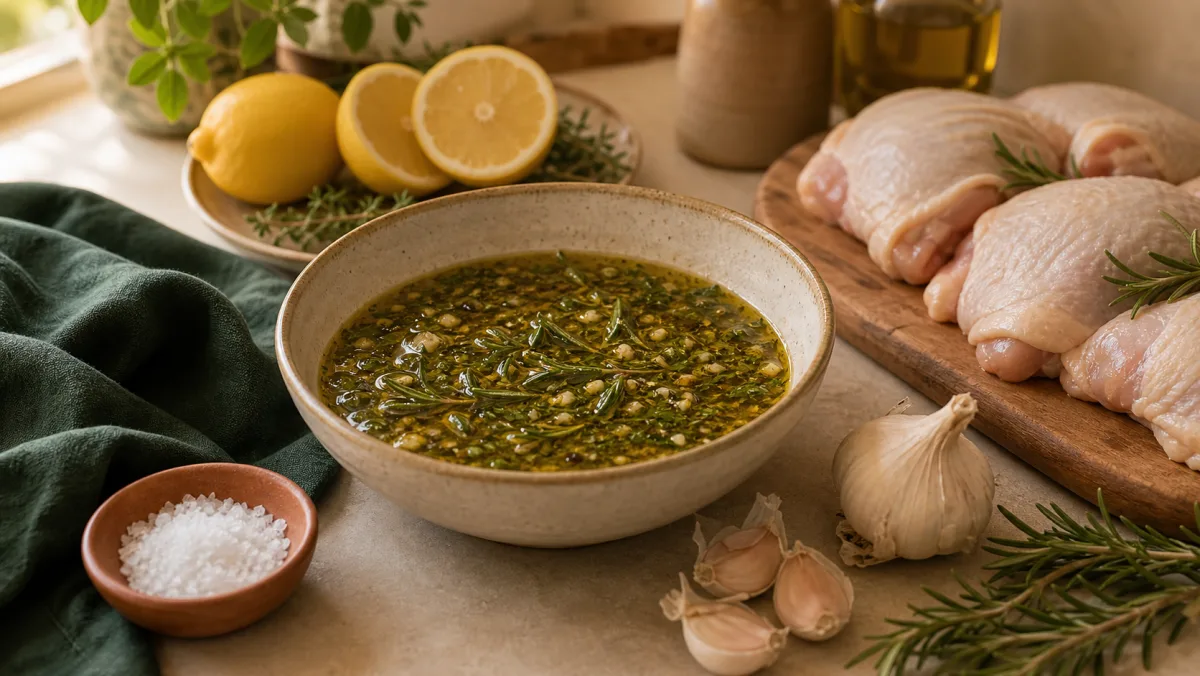
A marinade has two jobs: coat the food and season it. Doubling the meat does not always mean you need double the liquid if the food will be turned or sealed in a bag. But salt and acid still need discipline, because too much contact can make meat harsh, salty or mushy.
The scaling ratio
Start by scaling to the weight of meat or vegetables. Then ask whether the original marinade volume was just enough to coat or far more than needed. In a zip-top bag, less marinade covers more efficiently than in a wide dish.
Quick reference
Scale marinade components by job, not by habit.
| Component | Scaling move | Why |
|---|---|---|
| Oil | Scale close to meat factor | Helps coating and carries flavor |
| Acid, citrus or vinegar | Scale cautiously | Too much contact can toughen texture |
| Salt | Start 75-90% | Meat absorbs it over time |
| Soy sauce or fish sauce | Start 60-75% | Salt plus strong flavor |
| Fresh herbs | Scale to taste | Often best added partly at the end |
The marinade scaling workflow
- Weigh or estimate the food first; this is your real target.
- Choose container style: bag, shallow dish or bowl. Bags need less liquid.
- Scale oil and aromatics normally, but hold back some salt and strong salty sauces.
- Use the original marinating time as a ceiling when acid is high.
Worked example: chicken marinade for 2 lb instead of 1 lb
Original for 1 lb chicken: ¼ cup olive oil · 2 tbsp lemon juice · 1 tbsp soy sauce · 1 tsp salt · 2 cloves garlic.
For 2 lb, start with ½ cup olive oil · 3 tbsp lemon juice · 1½ tbsp soy sauce · 1½ tsp salt · 4 cloves garlic. If the meat is in a bag and coats well, you may not need every drop of liquid.
Marinade scaling traps
- Do not extend marinating time just because the batch is larger.
- Fish and thin cuts need gentler acid and shorter contact than dense roasts.
- Sugar in marinades burns faster on high heat; scaling up does not change that.
- Reserve fresh herbs or citrus zest for finishing if you want brighter flavor.
Skip the long division. Paste your ingredient list into the scaling pot and get every line converted at once.
Open the calculator