
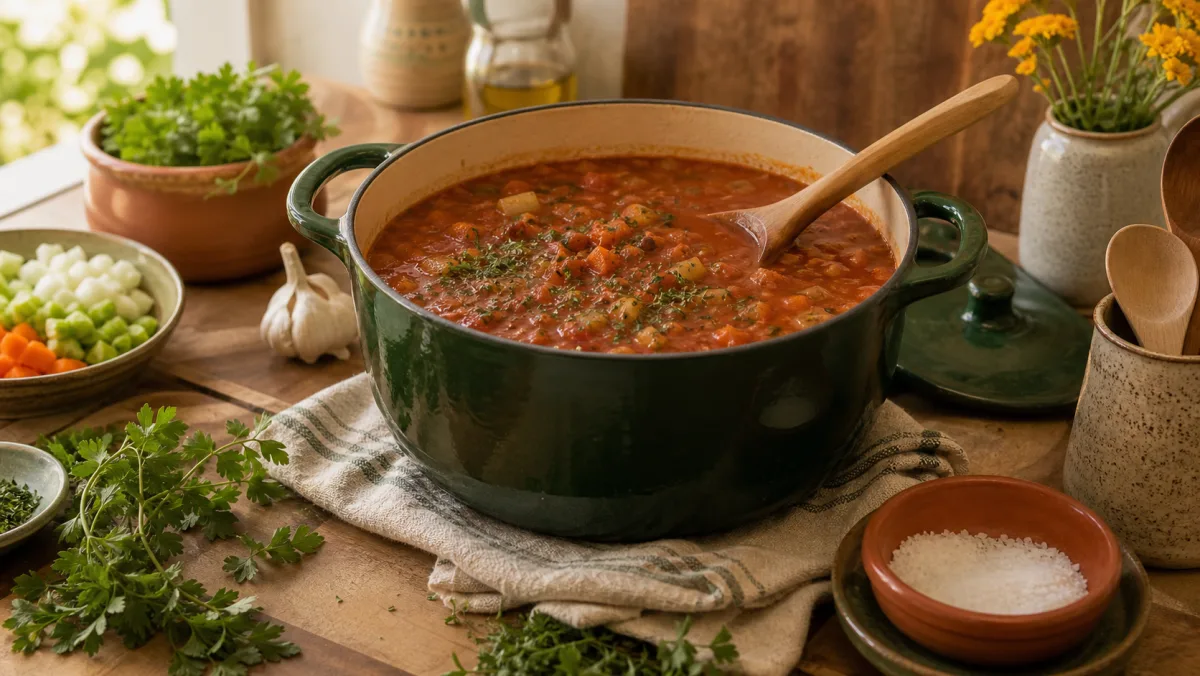
A doubled pot most often tastes unbalanced when every salty and spicy line is doubled before the final concentration is known. Soups, stews and sauces lose water as they simmer, and a larger batch in the same pot does not evaporate like the original. Build flavor in stages so the math remains a guide rather than a final seasoning decision.
The scaling ratio
The ingredient factor for a double batch is ×2. For salt, hot spices and salty condiments, add less than the paper number at first and finish by taste.
Quick reference
Different categories deserve different treatment in a doubled pot.
| Ingredient type | Starting move | Why |
|---|---|---|
| Meat, beans, vegetables | Scale ×2 | Bulk ingredients behave linearly |
| Water, unsalted stock | Scale ×2, then adjust texture | Simmering may reduce differently |
| Salt | Start around 75% of scaled amount | Oversalting is hard to fix |
| Soy sauce, bouillon, fish sauce | Start 60-75% | They bring salt plus strong flavor |
| Chile flakes, cayenne, hot sauce | Start around two-thirds | Heat perception compounds |
The staged-seasoning method
- Double the structural ingredients first: aromatics, protein, vegetables, beans, tomatoes and unsalted liquids.
- Add only part of the salt and heat at the beginning.
- Use a wider pot if the recipe relies on reduction; surface area matters more than raw volume.
- Taste near the end, after the pot has simmered and concentrated, then finish with salt, acid or heat.
Worked example: tomato soup for 8
Original for 4: 2 cans tomatoes · 2 cups stock · 1 onion · 1 tsp salt · ¼ tsp red pepper flakes.
Doubled: 4 cans tomatoes · 4 cups stock · 2 onions. Start with 1½ tsp salt instead of the full 2 teaspoons, and ⅓ tsp red pepper flakes instead of ½ teaspoon. Blend, simmer, then correct at the end.
Common savory scaling mistakes
- Do not double packaged bouillon blindly; its salt content can dominate the whole pot.
- A deeper pot reduces slowly and can taste watery until late. Give it time before adding more salt.
- Searing meat for a double stew should happen in batches so it browns instead of steaming.
- Acid brightens a large pot. A squeeze of lemon or splash of vinegar can fix flatness better than more salt.
Skip the long division. Paste your ingredient list into the scaling pot and get every line converted at once.
Open the calculator