
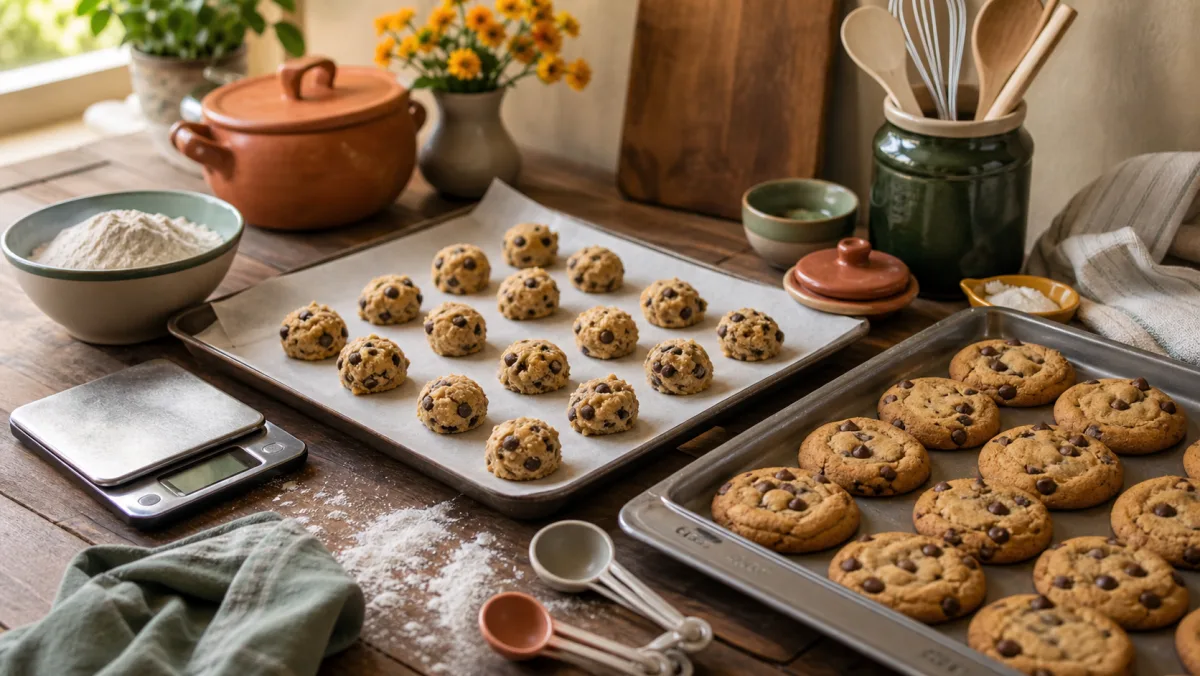
A cookie recipe's yield is unusually honest: if it says it makes 24 cookies, the number is usually tied to a scoop size. That gives you a clean ratio. Decide how many cookies you want, divide by the original yield, and multiply every ingredient by that factor. The only catch is behavioral: changing the scoop size changes the real yield, even when the ingredient math was perfect.
The scaling ratio
Use target cookies ÷ original cookies. A 24-cookie recipe scaled to 12 cookies is 12 ÷ 24 = ×0.5. To make 36 cookies, use 36 ÷ 24 = ×1.5. To make 48 cookies, use ×2.
Quick reference
Use this table when the original recipe makes 24 same-size cookies.
| Target yield | Factor | What it means |
|---|---|---|
| 12 cookies | ×0.5 | Half batch; one tray for most home ovens |
| 18 cookies | ×0.75 | Useful when you have one egg plus a half egg |
| 36 cookies | ×1.5 | One-and-a-half batch; often two trays |
| 48 cookies | ×2 | Double batch; bake in separate tray rounds |
| 60 cookies | ×2.5 | Party batch; check mixer capacity before starting |
The cookie scaling workflow
- Lock the scoop size first. A 2-tablespoon scoop and a 3-tablespoon scoop create different yields from the same dough weight.
- Scale dough ingredients linearly. Flour, sugar, butter, eggs, chocolate and nuts all multiply cleanly.
- Keep bake time tied to cookie size, not total batch size. Same-size cookies bake for the original minutes, tray by tray.
- Chill by dough behavior. A doubled bowl may take longer to firm in the refrigerator, but it is ready when the dough feels like the original.
Worked example: 24 chocolate chip cookies to 36
Original: 2¼ cups flour · 1 cup butter · ¾ cup sugar · ¾ cup brown sugar · 2 eggs · 2 cups chips · 1 tsp baking soda · ½ tsp salt.
Factor: 36 ÷ 24 = ×1.5. Scaled: 3⅜ cups flour (about 405 g) · 1½ cups butter · 1 cup + 2 tbsp sugar · 1 cup + 2 tbsp brown sugar · 3 eggs · 3 cups chips · 1½ tsp baking soda · ¾ tsp salt.
The bake time stays the same if the dough balls stay the same size. You simply bake more trays.
Where cookie scaling goes wrong
- Butter temperature matters more in big batches because mixing takes longer. Stop if the dough turns greasy and chill before scooping.
- A double batch can overload a small mixer. Finish chips and nuts by hand if the motor labors.
- Salt and baking soda scale linearly here; the dough is divided into small cookies, so the original chemistry stays intact.
- For a half batch with one egg, use one whole egg only if the original had two. If the original had one egg, whisk and weigh half an egg.
Skip the long division. Paste your ingredient list into the scaling pot and get every line converted at once.
Open the calculator