
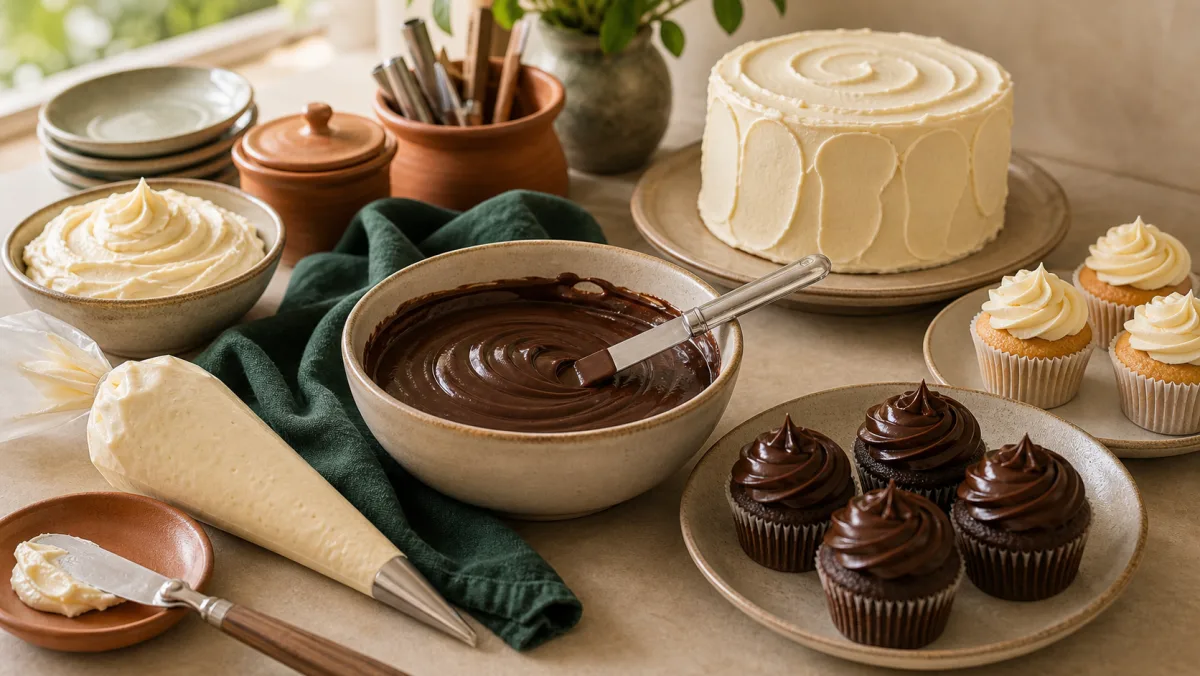
Cake batter scales by pan area and depth. Frosting scales by exposed surface and style. A naked cake, a thick crumb coat plus finish coat, a dozen cupcakes with tall swirls and a thin glaze all use different amounts even if the cake underneath is the same size.
The scaling ratio
Start with cake surface logic: more layers and more exposed sides mean more frosting. For simple glaze, pan area is usually enough. For ganache, keep the chocolate-to-cream ratio first, then scale total weight.
Quick reference
These are practical starting multipliers from a standard 8- or 9-inch layer cake frosting batch.
| Target | Starting frosting factor | Note |
|---|---|---|
| One 6-inch layer cake | ×0.5 to ×0.6 | Small cakes still have side area |
| One 9×13 sheet cake top only | ×0.7 to ×0.9 | No layer filling or side coat |
| 24 cupcakes, modest swirl | ×1.2 to ×1.5 | Swirl height changes everything |
| Two-layer 9-inch cake | ×1 | Original reference |
| Three-layer 9-inch cake | ×1.3 to ×1.5 | Extra filling plus height |
The frosting scaling workflow
- Decide coverage style first: glaze, top-only, filled layers, crumb coat, final coat or tall swirls.
- Scale the recipe conservatively if you can make more quickly; scale generously if matching color matters.
- For buttercream, adjust texture at the end with small additions of liquid or powdered sugar.
- For ganache, keep the ratio intact and scale total weight instead of improvising cream by feel.
Worked example: 9-inch layer cake frosting for a 9×13 sheet
If the original frosting covers and fills a two-layer 9-inch cake, a 9×13 sheet cake with frosting only on top often needs less than the full batch. Start around ×0.75.
For a buttercream with 2 cups butter · 6 cups powdered sugar · ¼ cup cream, ×0.75 gives 1½ cups butter · 4½ cups powdered sugar · 3 tbsp cream, then adjust texture after mixing.
Finishing mistakes
- Do not scale frosting by cake servings alone; decoration style changes yield more than serving count does.
- Food coloring is hard to match later. Make extra when a precise color matters.
- Warm ganache can look thin and then set firm. Let it cool before deciding it needs more chocolate.
- A very thin glaze needs enough volume to pour smoothly; below a small batch, make extra and accept leftovers.
Skip the long division. Paste your ingredient list into the scaling pot and get every line converted at once.
Open the calculator