
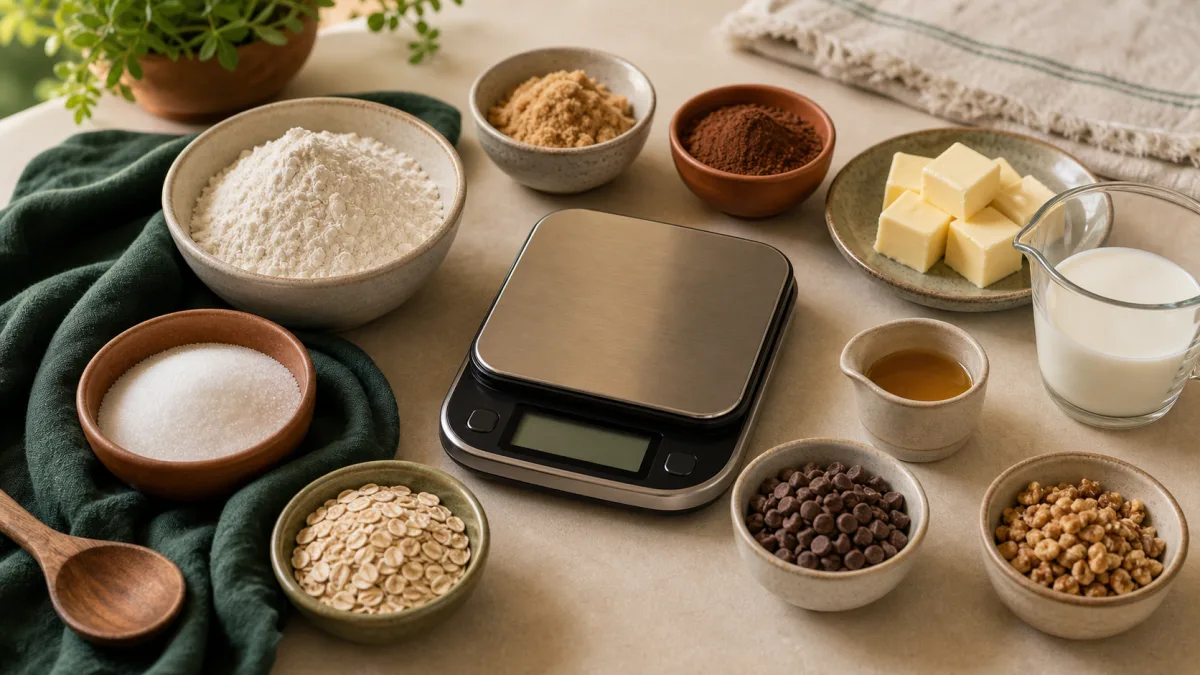
Cup measures are convenient until you scale them. Half of ¾ cup is manageable; 1.7 times ⅔ cup is not. Converting a recipe to grams before scaling gives every line the same simple operation: multiply the weight. This table uses a US 240 ml cup and spoon-and-level technique for powders.
The scaling ratio
Convert the original cup measure to grams, then multiply by the scaling factor. For example, 1½ cups all-purpose flour is about 180 g; scaled ×1.5, it becomes 270 g.
Quick reference
These are practical home-kitchen reference values, rounded for actual use.
| Ingredient, 1 US cup | Grams | Scaling note |
|---|---|---|
| All-purpose flour | 120 g | Spoon and level |
| Bread flour | 120 g | Spoon and level |
| Cake flour | 110 g | Very light; avoid scooping |
| Granulated sugar | 200 g | Reliable by volume |
| Brown sugar, packed | 215 g | Pack before leveling |
| Powdered sugar | 120 g | Unsifted |
| Cocoa powder | 85 g | Break lumps first |
| Rolled oats | 90 g | Do not compact |
| Chocolate chips | 170 g | Brand size varies |
| Butter | 227 g | Two US sticks |
| Vegetable oil | 220 g | Use scale or liquid cup |
| Honey | 340 g | Oil the spoon for clean release |
| Milk | 240 g | Close enough to water |
| Greek yogurt | 245 g | Spoon into cup |
| Peanut butter | 255 g | Weight is much cleaner |
| Chopped nuts | 120 g | Chop size matters |
| Shredded cheese | 115 g | Loose pack |
| Long-grain rice, raw | 185 g | Level the cup |
| Panko breadcrumbs | 55 g | Very airy |
| Raisins | 150 g | Do not press down |
How to use the table
- Convert the original volume into grams one ingredient at a time.
- Multiply the grams by your scale factor.
- Round sensible amounts: flour to the nearest 5 g, spices more tightly.
- If the recipe author gives grams, use their grams over any generic chart.
Worked example: 1.5× oatmeal cookies
Original: 1½ cups flour · 1 cup oats · ½ cup butter · ¾ cup brown sugar.
Convert first: 180 g flour · 90 g oats · 113 g butter · 160 g brown sugar. Scale ×1.5: 270 g flour · 135 g oats · 170 g butter · 240 g brown sugar.
Why charts disagree
- Scooped flour can weigh far more than spooned flour, so technique matters.
- A recipe's own gram weights beat any outside chart because the author tested with those numbers.
- Cup size differs by country. This site uses the US 240 ml cup.
- Very small amounts like baking soda should stay in teaspoons unless your scale reads tenths of a gram accurately.
Skip the long division. Paste your ingredient list into the scaling pot and get every line converted at once.
Open the calculator