
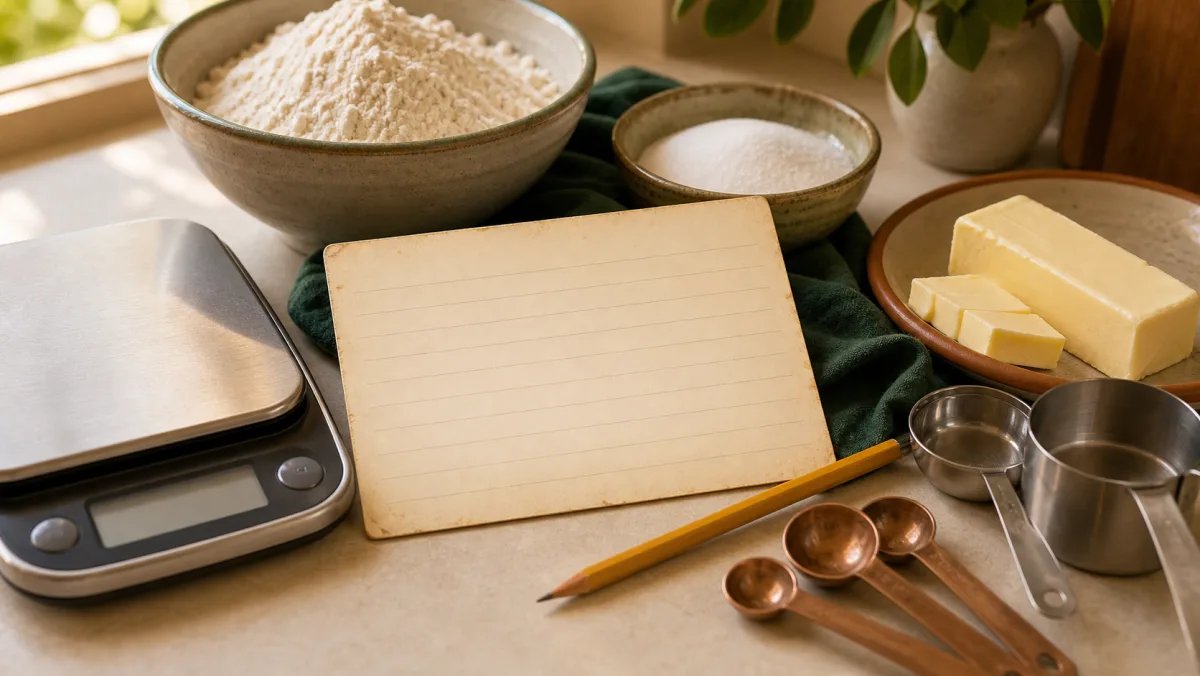
Scaling by cups forces you to solve two problems at once: multiplication and measuring-tool translation. Scaling by grams only requires multiplication. For frequently used recipes, convert the important ingredients to grams once and write those weights into your personal copy. From then on, half batches, 1.5× batches and larger batches become straightforward.
The scaling ratio
The method is: volume to grams first, then grams × scaling factor. The original recipe's own tested gram weights always win if they are provided.
Quick reference
Prioritize grams where volume is least reliable.
| Ingredient category | Why grams help | Volume still okay? |
|---|---|---|
| Flour and cocoa | Packing changes weight dramatically | Only for rough cooking |
| Nut butters and honey | Sticky cups are messy and variable | Scale is easier |
| Butter | Sticks already map cleanly to grams | Volume is acceptable |
| Milk and water | 1 ml is about 1 g | Yes |
| Spices under 1 tsp | Tiny gram weights need a precise scale | Spoons are fine |
Build your gram version
- Print or copy the recipe into a working note.
- Convert flour, sugar, fats and major liquids to grams using one consistent chart.
- Cook or bake the recipe once at 1× and record any adjustments you have validated in practice.
- Use that house version as the source for future scaling.
Worked example: banana bread
Original volume lines: 2 cups flour · ¾ cup sugar · ½ cup butter · 1 cup mashed banana. House grams: 240 g flour · 150 g sugar · 113 g butter · about 225 g banana.
For a 1.5× loaf-and-muffin batch, multiply: 360 g flour · 225 g sugar · 170 g butter · about 340 g banana. No awkward cup fractions required.
Rules for a trustworthy gram version
- Do not mix conversion charts inside one recipe.
- If your first 1× bake needed adjustment, record the adjusted number, not the theoretical one.
- Write down ingredient state: sifted flour, packed brown sugar, melted butter and chopped nuts all matter.
- Keep spoons for tiny leavening and spices unless your scale is accurate below 1 g.
Skip the long division. Paste your ingredient list into the scaling pot and get every line converted at once.
Open the calculator