
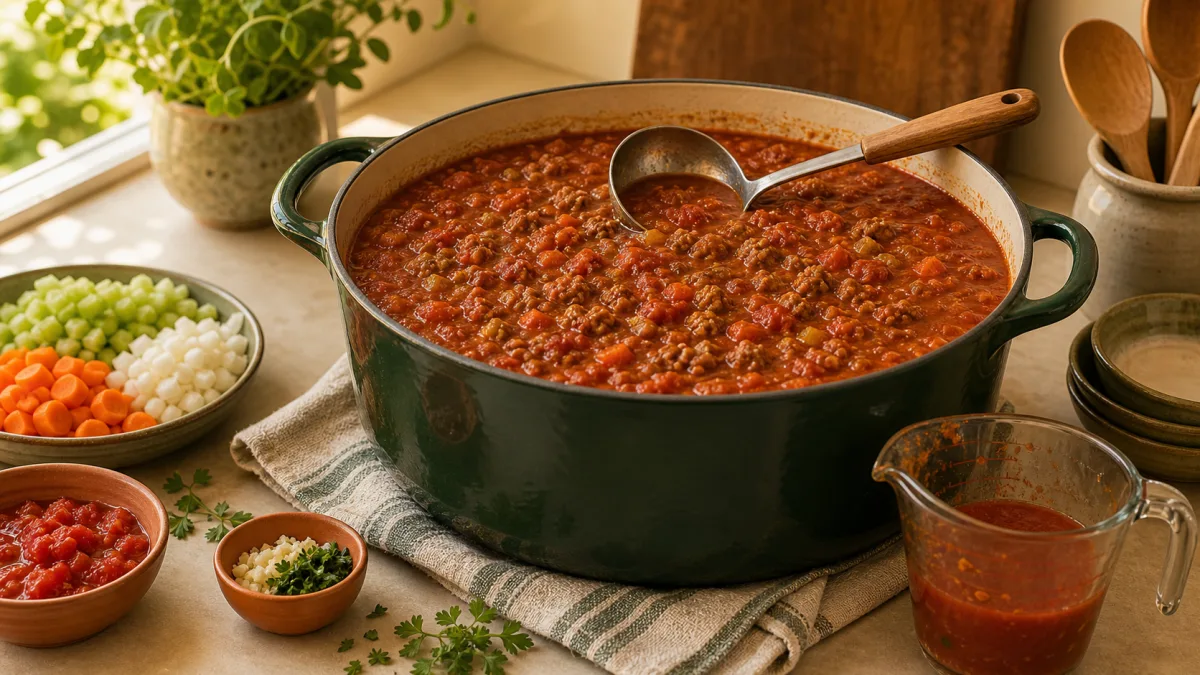
A tripled recipe often fails before flavor enters the conversation. The pot is too full to stir, the sauce takes forever to reduce, the burner cannot bring the mass back to a simmer, or the mixing bowl has no room for folding. Capacity is a real ingredient in large-batch cooking.
The scaling ratio
Tripling means ×3 for ingredients, but equipment needs headroom. For boiling, simmering or stirring, the pot should not be filled to the rim; leave enough space for bubbles, movement and safe handling.
Quick reference
Use finished volume plus headroom to choose a pot before ingredients are opened.
| Original batch | Tripled volume | Practical pot target |
|---|---|---|
| 4 cups sauce | 12 cups / 3 qt | 5-6 qt pot |
| 6 cups soup | 18 cups / 4.5 qt | 7-8 qt pot |
| 8 cups stew | 24 cups / 6 qt | 9-10 qt pot |
| 2 lb meat to brown | 6 lb | Brown in 3-4 rounds |
| 9×13 casserole | Three pans | Do not force into one deep pan |
The capacity-first workflow
- Estimate the original finished yield in cups or quarts.
- Multiply that yield by your factor, then add headroom for stirring and simmering.
- Split browning, sautéing or baking across batches when surface area matters.
- Plan longer heat-up and reduction time; the burner did not get three times stronger.
Worked example: tripling pasta sauce
Original yield: about 5 cups sauce in a 3-quart saucepan. Tripled yield: about 15 cups, or just under 4 quarts. A 4-quart pot is not enough once bubbling and stirring are considered. Use a 7- or 8-quart Dutch oven, or make two smaller batches.
Hold back some salt and chile until the sauce has reduced to its final texture.
Tripling changes workflow
- Crowded vegetables steam instead of sautéing. Cook aromatics in the largest pan you own or in rounds.
- A full pot is slow to respond. When it finally boils, it may boil over fast.
- One oversized baking dish creates a deeper center and different doneness; use multiple original-size dishes.
- Cooling a very large batch takes longer. Portion promptly instead of leaving one huge pot warm.
Skip the long division. Paste your ingredient list into the scaling pot and get every line converted at once.
Open the calculator