
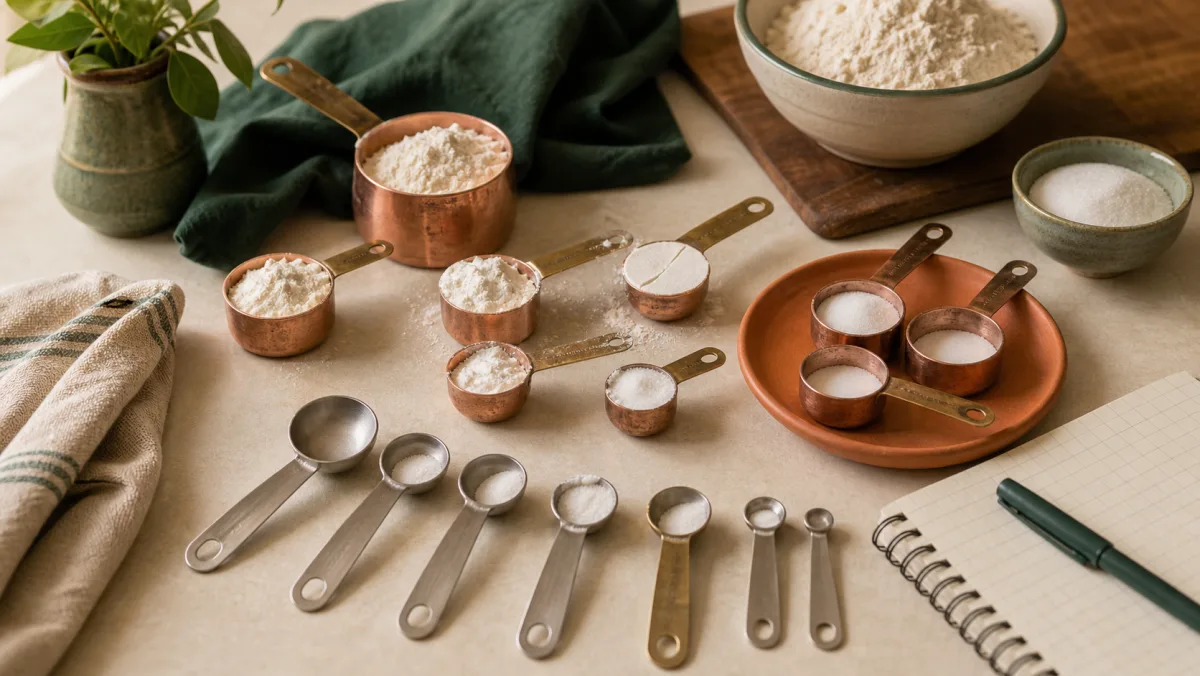
Most recipe-fraction errors come from trying to use a measuring cup that does not exist. There is no standard 3/8-cup measure, but there are tablespoons. Convert the original measure down the ladder, divide, then convert back only if it becomes simpler.
The scaling ratio
For halving, the factor is always ×0.5. The only question is how to display the result in real kitchen tools.
Quick reference
These are the awkward halves home cooks ask for most often.
| Original measure | Half | Practical way to measure |
|---|---|---|
| 1½ cups | ¾ cup | Use the ¾-cup line or ½ cup + ¼ cup |
| 1¼ cups | ½ cup + 2 tbsp | Half of 1 cup plus half of ¼ cup |
| ¾ cup | 6 tbsp | Or ¼ cup + 2 tbsp |
| ⅔ cup | ⅓ cup | Clean split |
| ⅓ cup | 2 tbsp + 2 tsp | Because ⅓ cup is 5 tbsp + 1 tsp |
| 1 tbsp | 1½ tsp | One teaspoon plus a half teaspoon |
How to solve any awkward half
- Break mixed numbers into whole cups plus the fraction.
- Convert the fraction to tablespoons if it does not halve cleanly.
- Convert tablespoons to teaspoons only when needed.
- For sticky or dense ingredients, weighing is usually faster than spoon arithmetic.
Worked example: half of 2¼ cups flour
Split 2¼ cups into 2 cups + ¼ cup. Half of 2 cups is 1 cup. Half of ¼ cup is 2 tablespoons. Result: 1 cup + 2 tbsp.
If the ingredient is all-purpose flour, the gram version is even cleaner: 2¼ cups is about 270 g, and half is about 135 g.
Do not over-precision your spoons
- Below 1/8 teaspoon, use a pinch unless the recipe is highly technical.
- Liquids can be measured in millilitres when spoon fractions become impractical.
- Packed brown sugar should be packed before measuring; powdered sugar should follow the recipe's sifted or unsifted wording.
- If a recipe uses grams, ignore the cup chart and divide the grams directly.
Skip the long division. Paste your ingredient list into the scaling pot and get every line converted at once.
Open the calculator